My sleep was disrupted for most of my life. And I couldn’t find a reason why. I started a small investigation and started sleep tracking. I was very surprised when I discovered this pattern: once a month I experience a severe blood oxygen drops (SpO2 desaturations), which I interpreted as a periodical sleep apnea.
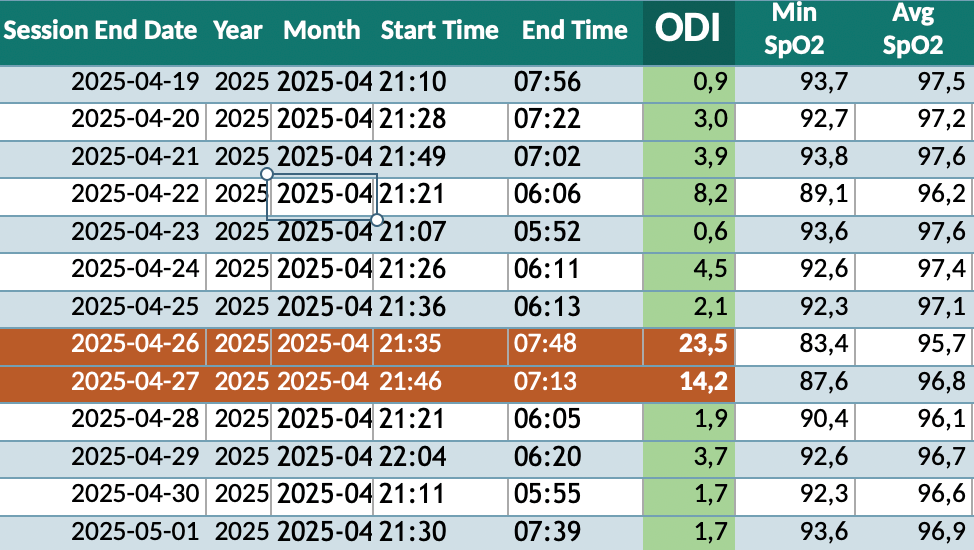
Figure 1: Raw data collected during a few nights in April 2025.
2 years ago I bought the Circul+ ring – a wearable that continously measures blood oxygen (SpO2) during sleep. I’ve been tracking my sleep for over 24 months now. And I discovered something I couldn’t explain for a long time, and no doctor wanted to give me feedback about.
About the device I used
The Circul+ ring by Bodimetrics measures SpO₂ (blood oxygen saturation) continuously with a sampling frequency of once per second (1 Hz). It is a reliable tool – its twin Circul Pro (exactly same hardware) is FDA approved for blood oxygen monitoring. For the quick comparison to other wearables, smartwatches and other rings measure blood oxygen in much higher intervals, e.g. Oura ring in 15 minutes intervals during sleep, Garmin up to 1 minute during sleep, 5-15 minutes during the day. I was mainly interested in blood oxygen drops. As these could be related to apnea events. Circul+ mobile app calculates so called ODI – oxygen desaturation index. This is an average number of 3% blood oxygen drops per hour.
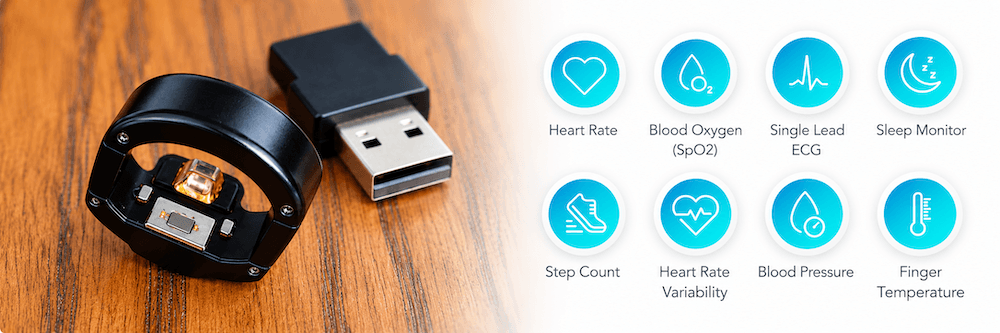
The Circul+ ring and its measurements.
What is ODI?
The Oxygen Desaturation Index (ODI) measures how many times per hour your blood oxygen drops. One “drop” is a desaturation event, typically by 3% or more. The ODI is an average calculated for the whole night during sleep. That’s why it is not a perfect metric. One could have no events in the first half of the night, but severe desaturations in the second half, and the results would be mild desaturation. Clinical significance: ODI serves as a reliable marker for the Apnea-Hypopnea Index (AHI) to help screen for obstructive sleep apnea (OSA). Here is the ODI formula:

- Normal: ODI < 5.
- Mild desaturation: 5 <ODI < 15
- Moderate desaturation: 15 < ODI < 30
- Severe desaturation: ODI > 30
Findings
For most of the nights my ODI’s were around 5. When I experienced difiifulties breathing, congested nose, sinusits, my ODI would be between 9 and 15.
The most surprising was the fact that once a month, usually around 20th of each month, there was a night when my ODI was extremely high, over 20, up to 30. I couldn’t explain this pattern, but I was sure there is some hidden cause behind it. I’ve been living in Austria during that period and went to the local GP, and then to internist to ask for some feedback. However none of them wanted to even look at these results. They both said that the wearables are toys in general, and not reliable for monitoring. I partly understand this, the “FDA approved”, although clinically significant, still not recognised in Europe – the doctors might be simply not allowed to use such devices in their practices.
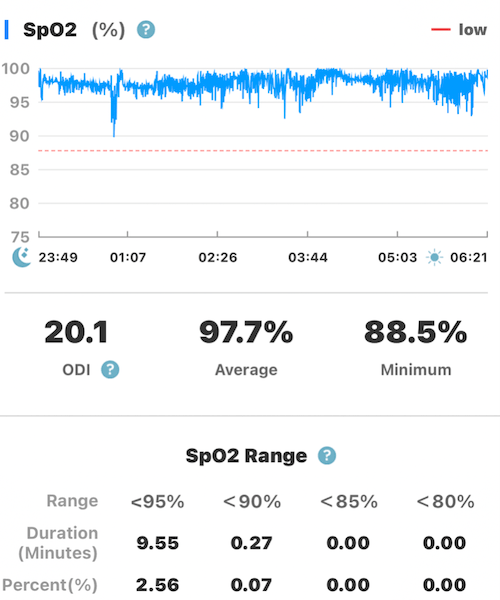
This is how a night report looks like in Circul+ mobile app. Here ODI=20.1
One year after, I found a doctor who gave me some context on what is possibly going on.
I’ve done some blood testing at Diagnostyka+, Poland’s largest network of medical labs offering the widest range of laboratory analyses. I’ve consulted one of their doctors to interpret my blood test results. The doctor was an internist, obesitologist, lipidologist and metabolic dietitian. During the conversation we went a little bit off topic and talked about RespireLabs and my private experiment with ODI. The doctor was very interested and intrigued that one of his patient was so deeply interested in similar topics as he was.
The doctor proposed a hypothesis and the next steps I should take in order to investigate this further.
My once-a-month high ODI, could be a sign of a man’s hormonal cycle. There is not enough statistical proof for that, but it seems like that, and it is worth to investigate it.
What’s next
Obviously my experiment is not a scientific study. I do it out of concern about my health and out of curiosity. Some of the next steps suggested by the doctor from Diagnostyka+:
- Do the sleep study (polysomnography) in the beginning of the month and after 20th.
- Test AMH hormone twice – after 20th and on 1st (exploratory investigation).
- Monitor with holter in&out possible window or as long as possible.
Science and Circul+
Several scientific studies suggest that the Circul+ ring may help identify people at risk of sleep apnea. In a study of 207 adults, the ring’s oxygen desaturation measurements closely tracked results from a laboratory sleep study (polysomnography), and it identified obstructive sleep apnea with reasonably good accuracy (ref. 1). A newer study of 164 patients also found good agreement with laboratory testing, with the authors concluding that a Circul oxygen desaturation index above about 13 events per hour may indicate significant sleep apnea (ref. 2). Another study compared several smart rings with laboratory sleep testing and highlighted an important limitation: while rings can collect useful physiological information, Circul’s estimates of sleep stages were much less accurate than the laboratory standard (ref. 3). Finally, researchers tested the Circul+ against oxygen levels measured directly from arterial blood and found good accuracy in both Black and non-Black participants, suggesting that its oxygen measurements were not significantly affected by skin pigmentation in that study (ref. 4).
- Zhao R, Xue J, Zhang X, et al. Comparison of ring pulse oximetry using reflective photoplethysmography and PSG in the detection of OSA in Chinese adults: a pilot study. https://pmc.ncbi.nlm.nih.gov/articles/PMC9394522/
- M M E Cruz et al., A wearable ring oximeter for detection of sleep disordered breathing. https://pubmed.ncbi.nlm.nih.gov/40220874/
- Herberger S, Aurnhammer C, Bauerfeind S, Bothe T, Penzel T, Fietze I. Performance of wearable finger ring trackers for diagnostic sleep measurement in the clinical context. https://www.nature.com/articles/s41598-025-93774-z
- Zhou C, Kryger M, et al. Validation of a smart ring oximeter in individuals with dark skin pigment. https://www.sciencedirect.com/science/article/pii/S2949761223000573
Krzysztof